Application Override
Application Override takes effect when a record in the PNT or in the FAC is assigned component-level security.
When component-level security is applied to a point in the PNT service, this security affects not only the point record, but permissions for that point in all other services in which it resides. When component-level security is applied to a facility in the FAC service, this security affects not only the facility record, but permissions for all of that facility’s points in all other services in which they reside, including the PNT. If component-level security is defined in both a PNT record and FAC record for the same point, the PNT security takes precedence.
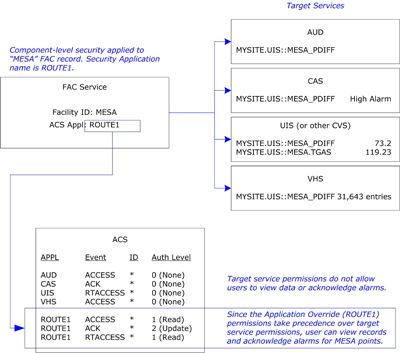
|
| Application Override Model |
Note:
Best practice recommends that point-level security application overrides should be used sparingly and judiciously. A memory-resident cache is used to check if points and/or facilities are configured with an application override. Long running security checks are completed in the background instead of blocking the updating of the client user interface until the checks complete. While this recommendation has no enforcement, it is possible for point-level security application overrides to become excessive, hindering client application performance.
A system with less than 1000 point records assigned an application override is considered reasonable. However, when the number of point records assigned an application override exceeds 10,000, significant performance degradation can occur when resolving security access in various client applications. The existing recommendation of sparse and judicious use of point-level security application overrides is encouraged.
FAC and PNT security overrides do NOT prevent administrative applications such as CygNet Explorer from reading data. However it does prevent CygNet Studio files from reading data. Also, ODBC will not honor the FAC and PNT overrides.
See Application Override Security Resolution Examples for more information.
More:
 Application Override Security Resolution Tree

